In a groundbreaking scientific endeavor, researchers have turned their attention to the ancient past, unlocking secrets buried within amber for millions of years. The discovery and potential resurrection of Eocene-era insect pathogens from amber-preserved viral libraries have opened a new frontier in paleovirology. This remarkable achievement not only sheds light on the evolutionary history of viruses but also raises profound questions about the risks and benefits of reviving ancient pathogens.
The study centers around amber, a natural time capsule that has preserved countless organisms in exquisite detail. While most attention has been paid to visible fossils like insects and plant matter, scientists have recently focused on something far smaller and potentially more significant - ancient viral particles trapped within these golden tombs. The Eocene epoch, spanning from 56 to 33.9 million years ago, was a period of dramatic climate change and evolutionary innovation, making it particularly interesting for virologists studying pathogen evolution.
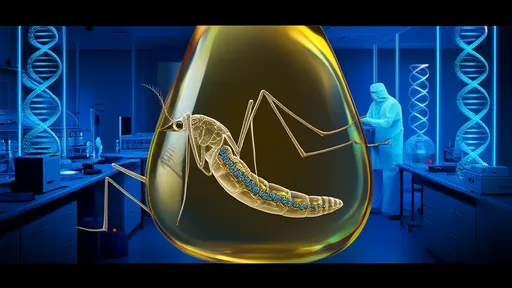
What makes this research particularly extraordinary is the successful extraction and sequencing of viral genetic material from amber-entombed insects. Using advanced paleogenetic techniques, researchers have painstakingly reconstructed partial genomes of viruses that infected insects during the Eocene. These viral sequences represent a previously untapped reservoir of ancient genetic information, offering unprecedented insights into the co-evolution of insects and their pathogens over geological timescales.
The process begins with carefully selected amber samples containing well-preserved insect specimens. Through non-destructive imaging techniques, scientists identify specimens showing potential signs of ancient infections. These might include unusual morphological features or discoloration that could indicate pathological conditions. The selected samples then undergo a delicate extraction process where microscopic amounts of preserved tissue are removed for genetic analysis.
One of the most surprising findings has been the discovery of viral lineages that no longer exist in modern ecosystems. These "lost" viruses display unique genomic architectures that differ significantly from contemporary insect pathogens. Some appear to represent entirely new viral families, while others show distant relationships to modern groups but with substantial evolutionary divergence. This genetic novelty suggests that the Eocene hosted a much greater diversity of viral forms than exists today, possibly due to different ecological conditions or host-parasite dynamics.
The ethical implications of this research have sparked intense debate within the scientific community. While the study of ancient viruses can provide invaluable information about viral evolution and host adaptation, the potential risks of resurrecting extinct pathogens cannot be ignored. Researchers emphasize that current work focuses solely on genetic characterization rather than functional reconstitution of complete, infectious viruses. Strict biocontainment protocols govern all aspects of the research to prevent any accidental release of ancient genetic material.
From a technical perspective, the challenges of working with such ancient genetic material are immense. DNA and RNA degrade over time, even in the near-perfect preservation conditions provided by amber. Scientists have had to develop novel methods for amplifying and sequencing these fragmented molecules, often working with pieces just a few dozen nucleotides long. Advanced computational techniques then help stitch these fragments together into coherent sequences that can be analyzed and compared to modern viruses.
The evolutionary insights gained from this research are already reshaping our understanding of virus-host interactions. By comparing Eocene-era viruses with their modern counterparts, scientists can track how viral genomes have changed over tens of millions of years. Some viral families show remarkable stability in their core genes, while others have undergone dramatic restructuring. These patterns provide clues about the selective pressures that have shaped viral evolution and may help predict how modern viruses might evolve in response to environmental changes.
Beyond pure scientific curiosity, this research has potential practical applications. Understanding how ancient viruses interacted with their hosts could inform modern approaches to pest control and disease management. The unique biological properties of these ancient pathogens might inspire new antiviral strategies or reveal previously unknown vulnerabilities in modern insect pests. Additionally, studying how viruses adapted to past climate changes could provide insights into how modern pathogens might respond to current global warming trends.
Looking ahead, researchers plan to expand their investigations to amber samples from different geographical locations and time periods. This broader sampling could reveal how viral diversity changed over time and space, and how it correlated with major evolutionary events like mass extinctions or climate shifts. There are also efforts underway to develop more sophisticated methods for recovering and analyzing ancient viral proteins, which could provide additional layers of information beyond genetic sequences alone.
The amber viral library represents just the beginning of what promises to be a transformative field in evolutionary biology and virology. As techniques improve and more samples are analyzed, we may gain an increasingly detailed picture of the ancient virosphere and its interactions with long-extinct ecosystems. While caution remains paramount when dealing with ancient pathogens, the potential rewards for science and medicine could be substantial. This research stands as a testament to how cutting-edge science can extract remarkable knowledge from the most unlikely of sources - tiny time capsules preserved in tree resin millions of years ago.
Public reaction to these developments has been mixed, with some expressing fascination at the scientific possibilities and others voicing concerns about potential risks. Science communicators face the challenge of explaining the careful safeguards in place while acknowledging the legitimate questions raised by such research. Ongoing dialogue between scientists, ethicists, and the public will be crucial as this field continues to develop and as our ability to study ancient pathogens becomes increasingly sophisticated.
From a broader perspective, this research highlights how much remains to be discovered about Earth's deep biological history. The fact that amber can preserve not just physical structures but also molecular information opens up exciting possibilities for studying other aspects of ancient life. Future studies might reveal not just pathogens but also beneficial microbes, environmental DNA, or even clues about the molecular biology of extinct species. Each new discovery adds another piece to the immense puzzle of life's evolutionary journey.
By /Aug 5, 2025

By /Aug 5, 2025
By /Aug 5, 2025

By /Aug 5, 2025
By /Aug 5, 2025
By /Aug 5, 2025
By /Aug 5, 2025
By /Aug 5, 2025

By /Aug 5, 2025
By /Aug 5, 2025

By /Aug 5, 2025
By /Aug 5, 2025
By /Aug 5, 2025

By /Aug 5, 2025

By /Aug 5, 2025

By /Aug 5, 2025

By /Aug 5, 2025

By /Aug 5, 2025

By /Aug 5, 2025

By /Aug 5, 2025