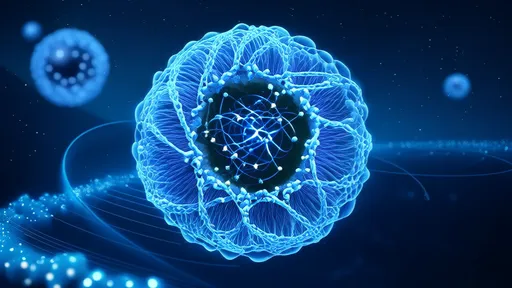
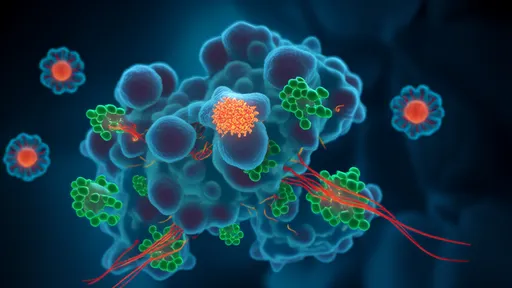
The intricate dance of cellular forces has long fascinated researchers studying cancer metastasis. Recent breakthroughs in mapping the mechanical interplay between cells and their microenvironment are revealing how physical stresses propagate through biological systems, creating highways for malignant spread. At the heart of this discovery lies the mechanotransduction signaling network - a sophisticated language of push and pull that tumor cells exploit during their deadly migration.
Mechanical memory in metastatic cells emerges as a startling feature of disease progression. Unlike their benign counterparts, aggressive cancer cells demonstrate an uncanny ability to retain physical experiences from previous microenvironments. This mechanical imprinting alters their response to new physical challenges, essentially creating cellular "muscle memory" for invasion. The cytoskeleton serves as both scribe and executor of this memory, reorganizing itself based on past encounters with stiffness gradients or shear stresses.
Three-dimensional force mapping technologies have uncovered surprising patterns in how tumors remodel surrounding tissues. Rather than simple brute-force displacement, metastatic cells employ sophisticated force modulation - exerting precisely timed pulses of tension followed by periods of mechanical quiescence. This pulsatile behavior allows them to probe structural weaknesses in extracellular matrices while avoiding detection by nearby healthy cells that might otherwise trigger defensive responses.
The emerging paradigm of mechano-metabolic coupling reveals how physical stresses reprogram cancer cell energetics. Compression forces dramatically alter mitochondrial networks, while shear stresses trigger rapid glycolysis upregulation. This metabolic plasticity enables circulating tumor cells to survive the harsh mechanical environments of blood vessels and lymphatic channels. Researchers now observe that mechanical stimuli can override genetic signals in determining metabolic preferences during different stages of metastasis.
Perhaps most clinically significant is the discovery of mechano-immunological crosstalk. Physical stresses created by growing tumors don't just affect cancer cells - they distort immune cell membranes and cytoskeletons in ways that paralyze anti-tumor responses. Certain metastatic cells even appear to "hijack" force-sensitive immune signaling pathways, converting defensive signals into pro-invasion cues. This mechanical subversion of immunity may explain why some immunotherapies fail against mechanically active tumors.
New therapeutic strategies are emerging from these insights. Mechano-disruptive agents that specifically target stress-transmitting cellular structures show promise in preclinical models. Unlike traditional cytotoxic drugs, these compounds don't necessarily kill cancer cells but rather "unplug" them from their mechanical support networks. Early-stage clinical trials are testing whether disrupting mechanical memory can make metastatic cells more susceptible to existing treatments.
The diagnostic implications are equally profound. Mechanical phenotyping of circulating tumor cells may soon provide clinicians with real-time information about a cancer's metastatic potential. Microfluidic devices that measure single-cell stiffness and force generation could stratify patients based on mechanical aggressiveness rather than just genetic markers. This approach might detect the earliest signs of metastatic transition before traditional imaging could reveal secondary tumors.
As research progresses, scientists are confronting the complex hierarchy of mechanical signaling in metastasis. Local forces at the cellular level integrate with tissue-scale stresses and even organ-level mechanical environments. This multi-scale mechanical integration suggests that effective anti-metastatic strategies may need to address physical stresses across all these dimensions simultaneously. The challenge lies in developing interventions that disrupt pathological force transmission without compromising normal tissue mechanics essential for health.
The clinical translation of these discoveries faces unique hurdles. Unlike molecular targets, mechanical properties exist in constant flux and vary dramatically between microenvironments. Therapeutic windows for mechano-based interventions must account for this dynamic nature. Nevertheless, the growing appreciation of cancer's mechanical dimension is opening entirely new avenues for understanding and combating metastasis at its physical roots.
By /Aug 5, 2025
By /Aug 5, 2025
By /Aug 5, 2025

By /Aug 5, 2025

By /Aug 5, 2025

By /Aug 5, 2025

By /Aug 5, 2025

By /Aug 5, 2025

By /Aug 5, 2025
By /Aug 5, 2025

By /Aug 5, 2025
By /Aug 5, 2025
By /Aug 5, 2025

By /Aug 5, 2025
By /Aug 5, 2025

By /Aug 5, 2025

By /Aug 5, 2025

By /Aug 5, 2025

By /Aug 5, 2025
By /Aug 5, 2025